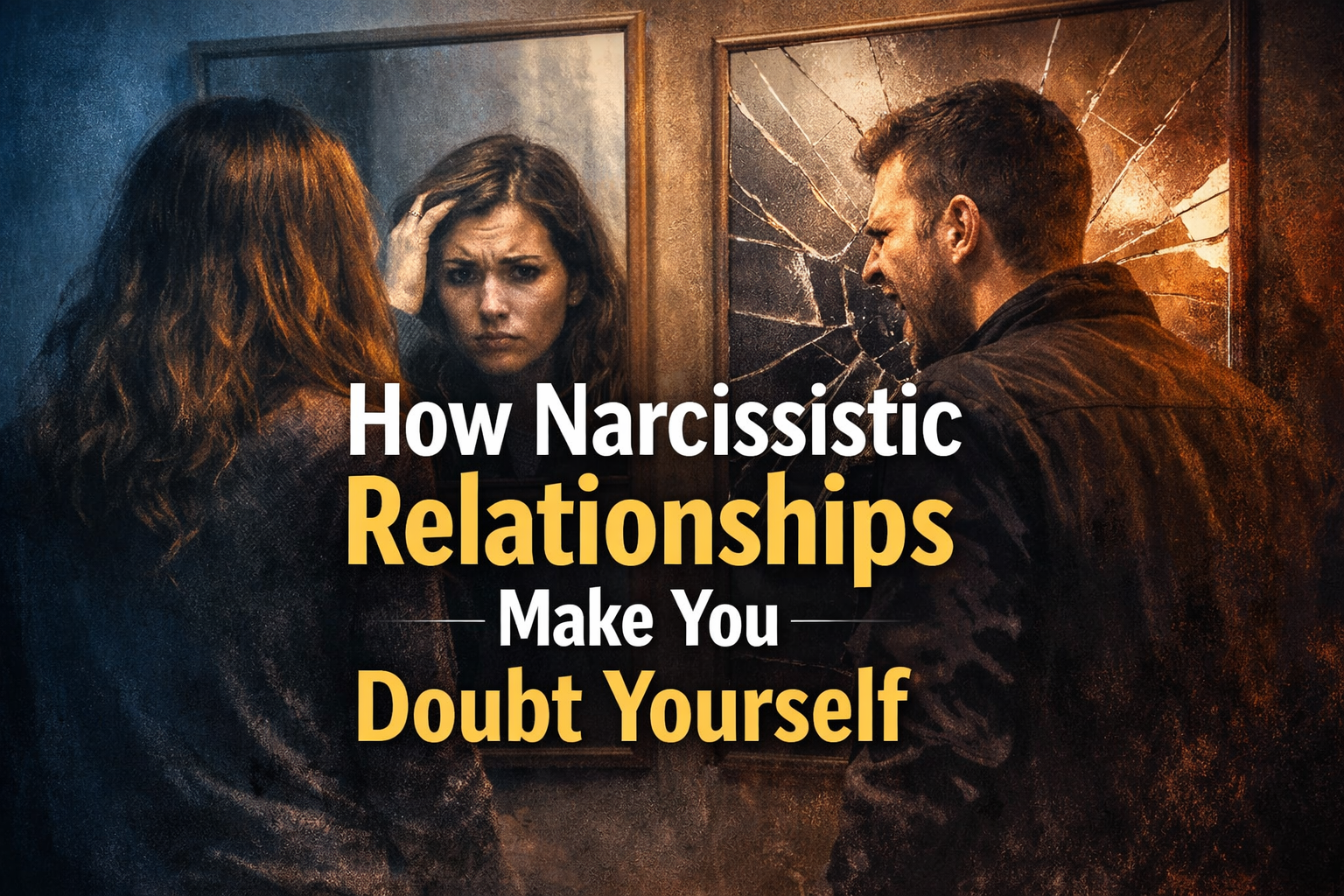
Narcissistic relationships are relationship dynamics where one partner repeatedly centers their needs, image, or emotions at the expense of the other partner’s reality, boundaries, and wellbeing, often through cycles of intensity, devaluation, and control.
Most people do not enter narcissistic relationships expecting harm. They enter them feeling seen, chosen, and deeply connected. At first, the relationship may feel unusually meaningful, as though something long-sought has finally arrived. That early sense of recognition can be powerful enough to override caution, especially for those who value intimacy, empathy, and emotional depth.
This is where the story often begins, and it is also where shame eventually takes hold. Many people leave narcissistic relationships asking themselves how they could have missed the signs. But narcissistic dynamics do not announce themselves as cruelty. They arrive disguised as connection, devotion, or vulnerability. They take hold not because someone is weak, but because they are open.
At its core, a narcissistic relationship is defined by imbalance. One person uses the relationship to regulate their sense of worth, control, or identity, while the other adapts, accommodates, and slowly disappears.
This imbalance rarely feels dramatic at first. It develops quietly, through subtle shifts in power and perception, until the relationship no longer feels safe, but leaving feels impossible.
What makes narcissistic relationships particularly difficult to recognize is that they often include moments of genuine warmth. There may be insight, remorse, or affection that keeps hope alive. These moments convince the other person that if they communicate better, love harder, or stay patient longer, the relationship will return to its early promise.
Over time, this intermittent reinforcement creates a powerful emotional bond that feels like love but operates more like dependence.
Understanding how narcissistic dynamics commonly present in men and women can help clarify why they are so difficult to name. The differences are not rooted in biology, but in how power, approval, and emotional expression are socially shaped.
In men, narcissistic traits often present externally. Control may appear overt, expressed through dominance, authority, or an emphasis on achievement and status. Emotional needs, especially those of a partner, may be minimized or dismissed when they interfere with self-image.
Criticism can provoke defensiveness, anger, or contempt. Conversations may feel one-sided, with the man positioning himself as the final authority on what is reasonable, logical, or true. Over time, partners may feel talked over, corrected, or subtly intimidated, absorbing the message that his perspective defines reality.
In women, narcissistic dynamics are often more relational and emotionally framed. Control tends to operate through guilt, withdrawal, or emotional dependency rather than overt dominance.
There may be a strong identification with being misunderstood, unappreciated, or perpetually self-sacrificing. Victimhood and entitlement can coexist in ways that are difficult to name. Partners may feel responsible for managing her emotional state, soothing distress, or constantly reassuring her value.
Boundaries are often experienced as rejection, and autonomy is framed as abandonment. The underlying message, though quieter, is just as consuming: her emotional needs must always take precedence.
In both cases, the result is the same. One person’s emotional world expands while the other’s contracts. Over time, the non-narcissistic partner begins to doubt their perceptions. This is often reinforced through gaslighting, which rarely takes the form of blatant denial.
Instead, it shows up as subtle reframing. Feelings are labeled as overreactions. Memories are questioned. Concerns are redirected back as flaws. Gradually, self-trust erodes.
Many people begin to feel anxious before conversations, rehearse their words to avoid conflict, or experience relief when the other person is in a good mood.
These are not signs of love. They are signs of emotional vigilance. The body often recognizes danger long before the mind is willing to name it.
Leaving rarely brings immediate relief. It often brings grief, doubt, and an aching sense of loss, not only for the relationship, but for the version of oneself who believed so deeply in themselves.
There may be moments of longing for the intensity, the closeness, the early sense of meaning. These feelings do not mean the decision to leave was wrong. They mean the bond was real, even if the relationship was not healthy.
With narcissistic women, partners often struggle with the fear of abandoning someone who appears fragile or wounded.
With narcissistic men, there may be fear of retaliation, dismissal, or character assassination. In both cases, the person leaving is often left carrying shame that does not belong to them.
Finding a Path to Healing
Healing after a narcissistic relationship is not about becoming guarded or emotionally closed off to others. It is about reclaiming the parts of yourself that were silenced. It is about rebuilding trust in one’s perceptions and learning to distinguish between intensity and intimacy. It involves understanding that empathy does not require self-sacrifice, and that compassion does not mean enduring harm.
Many people in recovery find that they must unlearn deeply ingrained beliefs about love.
It's important to remember that healthy relationships do not demand constant explanation. They do not punish boundaries or require emotional performance. Holding them accountable can lead to repair rather than blame.
Conflict leads to understanding rather than confusion. There is space for both people to exist fully, without one shrinking to accommodate the other.
Perhaps the most powerful form of protection we can offer ourselves and others is language. When people can name what they are experiencing, shame loosens its grip. Awareness does not exist to label or condemn, but to expose and bring out into the open to discuss.
Many people remain in harmful relationships not because they are weak, but because they lack a framework for understanding what is happening to them.
You do not need a diagnosis to protect yourself. You do not need to justify your pain to deserve peace. If a relationship consistently leaves you feeling smaller, less certain, or disconnected from your sense of self, that information matters.
Trusting yourself again is not a dramatic act. It begins quietly, with the decision to listen when something inside says that this is not what love is supposed to feel like.
Protection begins there. Healing follows when you choose truth over confusion, and self-respect over survival.
Download the below guides for more help.
Frequently Asked Questions
What are the signs of a narcissistic relationship?
A narcissistic relationship often includes chronic confusion after conflict, repeated dismissal of your feelings, boundary pushback, blame-shifting, and a pattern where one person’s needs consistently outweigh the other’s.
Do narcissistic relationships look different in men and women?
They can. Men’s narcissistic patterns more often show up through overt dominance, status, and intimidation, while women’s patterns more often show up through relational control, guilt, withdrawal, and victim framing. The core dynamic—imbalance and lack of accountability—remains the same.
What is trauma bonding and why does it make leaving hard?
Trauma bonding is an attachment formed through cycles of affection and harm. The unpredictability of warmth and withdrawal can create a powerful craving for relief, making the relationship feel addictive.
How do I protect myself if I’m not ready to leave?
Focus on rebuilding self-trust, limiting emotional disclosure, documenting patterns for clarity, strengthening support outside the relationship, and setting small boundaries you can sustain.
Can a narcissistic person change?
Some people with narcissistic traits can improve with sustained accountability and long-term therapy, but meaningful change is uncommon without consistent effort over time. Your safety and wellbeing should not depend on potential change.
Here are other ways we can help:
Individual Christian Counseling/Coaching:
Our Christian coaching/counseling sessions are tailored to assist you in healing and wellness. Whether you're feeling trapped, in a spiritual rut or desiring to gain a more comprehensive understanding of God's plan for your life, our Christian coaching/counseling can provide the guidance you need.